Textile · 13 November, 2026
Textile Recycling: New Opportunities and Industry Bottlenecks in Vietnam
The textile and apparel industry is entering a period in which production capacity is no longer the only criterion determining a company’s position. Alongside price, quality and delivery time, international brands are increasingly concerned with the origin of raw materials, the ability to reduce emissions, the use of recycled materials and plans for handling products after they reach the end of their life cycle.
This change creates additional pressure for manufacturers, but it also opens up a new development path: building supply chains based on circular materials. For Vietnam, where most textile and apparel companies participate in export-oriented manufacturing chains, recycling is not merely an environmental issue. It is also connected to the ability to retain orders, meet customer requirements and increase value within the supply chain.
However, shifting from a model based on virgin materials to a circular model cannot be achieved simply by purchasing recycled yarn. Companies must address several issues at the same time, from waste sorting, quality control, product design and traceability to investment costs and the market for post-recycling materials.
Environmental regulations are changing the textile industry’s approach
The European Union is one of the regions most strongly promoting the transformation of the fashion and textile industry. In the EU Strategy for Sustainable and Circular Textiles, published by the European Commission in 2022, the body set out the goal of promoting textile products that are durable, easy to repair and recyclable, and that are produced under conditions that respect the environment and social rights.
This strategy does not merely encourage companies to change voluntarily. It provides direction for a series of regulations related to product design, durability information, recycled content, producer responsibility and the management of unsold inventory. For suppliers outside the EU, the impact may emerge through the technical requirements and purchasing standards of brands.
The EU’s Ecodesign for Sustainable Products Regulation, which took effect in July 2024, expands the scope of regulation beyond energy consumption. It provides a basis for introducing specific requirements for different product groups, with textiles among the groups receiving priority consideration. Relevant areas may include durability, repairability, resource use and product information.
The EU has also introduced rules restricting the destruction of unsold apparel and footwear for certain groups of businesses. Although Vietnamese companies are not directly subject to every obligation in the same way as a company selling products in the EU market, these rules may still affect how brands manage products, place orders, design items and select suppliers.
One notable point is that environmental requirements are shifting from waste treatment to the entire product life cycle. A shirt made from recycled yarn but difficult to repair, made from multiple blended fibers or impossible to sort when discarded may not necessarily meet circularity goals. As a result, recycling is increasingly connected to design decisions made before a product is sewn.
Textile recycling is not just about collecting old clothes
In textile and apparel production, waste can arise at many stages. Spinning mills generate short fibers and raw materials that fail to meet requirements. Weaving, dyeing and finishing facilities produce fabric ends, defective fabric or products that do not match an order. Cutting and sewing generate large quantities of fabric scraps. There are also returned garments, defective goods, unsold inventory and post-consumer products.
These types of waste do not have the same value and cannot all be processed using a single technology. Clean waste that is uniform in composition and color is generally easier to return to the production process. By contrast, fabric made from multiple blended fibers or containing coatings, metal accessories, zippers, buttons or chemical contamination requires additional dismantling and treatment.
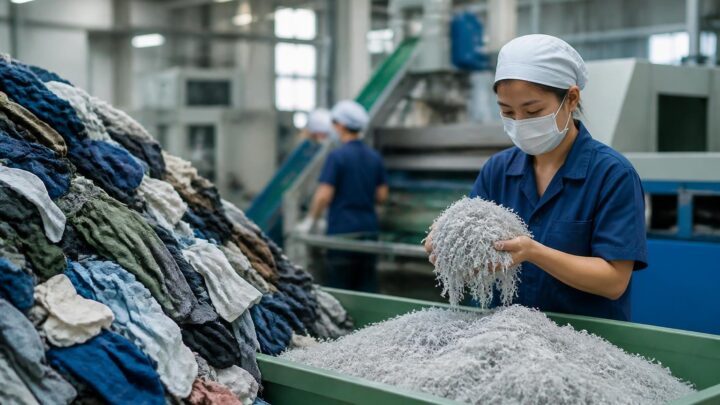
Technically, textile recycling is generally divided into three main approaches. Mechanical recycling uses shredding, grinding or carding processes to turn fabric into fiber. This method is relatively common, but fiber length generally decreases after each round of processing. Recycled fiber may therefore need to be blended with virgin fiber to ensure strength and spinnability.
Thermal or chemical recycling seeks to separate and regenerate materials at the polymer or molecular level. For some types of synthetic fibers, this technology can produce raw materials with more stable properties than those obtained through mechanical recycling. Nevertheless, investment costs, requirements for the purity of input materials, chemical control and the ability to operate at commercial scale remain major challenges.
The third approach is reuse or recycling for lower-value applications, such as turning old clothes into wiping materials, soundproofing materials or other industrial products. This is still part of the circular economy, but it should not be equated with fully closing the life cycle to create new textile products.
Design determines recyclability
The more complex a product is, the higher the cost of recovery and sorting. Designs that use multiple layers of material, difficult-to-separate blends or numerous accessories may create attractive and functional products, but they also create difficulties at the end of the product’s life.
Companies can improve recyclability by reducing the number of unnecessary components, selecting compatible materials, designing seams that are easy to dismantle and managing information about fiber composition. The use of clear identification labels can also help collectors and processing facilities sort materials more accurately.
For contract manufacturers, this is an issue that needs to be discussed with customers at an early stage. If a company receives only technical specifications during the production phase, its ability to influence design will be limited. Conversely, participating from the sample-development stage can help a factory propose materials, reduce waste and standardize recovery processes.
What bottlenecks are Vietnamese companies facing?
The first bottleneck is the unstable supply of recycled raw materials. A factory needs materials with suitable composition, color, fiber length and moisture content. Meanwhile, textile waste in Vietnam is often dispersed across individual workshops, orders and localities. The lack of a standardized sorting system increases collection, transportation and testing costs.
The second bottleneck is quality. Not every material labeled “recycled” has the same quality. Recycled yarn can affect the strength, evenness, color or processing performance of fabric. Without effective control, companies face higher defect rates, customer complaints or difficulties meeting the technical standards of individual brands.
The third bottleneck concerns traceability. International customers do not only want to know whether a product uses recycled materials. They also need information about the source of the raw materials, the processing methods and the blending ratio. Certification systems and third-party standards can support verification, but companies still need to maintain complete internal records from the receipt of raw materials through shipment.
The next bottleneck is investment capital. A recycling line requires equipment, facilities, quality-control systems and technical personnel. For small and medium-sized enterprises, investing in a separate line may not be efficient if the volume of waste is not yet large enough or the market for the output is not guaranteed. Cooperation within industrial clusters, outsourcing processing services or partnering with specialized companies may be more suitable options during the initial stage.
Finally, there is the market challenge. Recycled materials are not automatically cheaper than virgin materials. Prices depend on the supply of waste, technology, recovery rates, quality standards and certification costs. Companies can expand only if customers are willing to order the products, rather than if they merely conduct trials without sales contracts.
From waste treatment to building a new value chain
A more effective approach is to view waste as a material stream that needs to be managed rather than as a cost that must be eliminated. Companies can begin by mapping waste streams within the factory: identifying which types of waste arise at each stage, their approximate volume, level of cleanliness, fiber composition and potential for reuse.
Sorting at the source is often decisive. Fabric scraps separated by composition and color have greater processing value than mixed waste. Companies also need clear storage procedures to prevent recycled materials from becoming damp, contaminated with oil or mixed with foreign substances.
At the product level, companies should work with customers to define appropriate goals. Not every product needs to achieve the highest possible recycled-material content. In some cases, prioritizing durability and extending the period of use may create greater environmental benefits than increasing the recycled content while reducing product lifespan.
Data tools will also become increasingly important. Material management systems can record yarn batches, suppliers, blending ratios and test results. As requirements for product information become more demanding, data standardized at an early stage will help companies reduce customer response times and limit the risk of discrepancies in records.
Opportunities for technology and service providers
The development of textile recycling creates opportunities not only for garment factories. Related fields such as waste sorting, fiber testing, water treatment, product design, traceability software and reverse logistics also have room to expand.
Technology companies can provide small-scale solutions suited to individual production clusters rather than targeting only large factories. Collection companies can build specialized sorting networks for textile waste. Universities and research institutes can support material testing, process optimization and technical workforce training.
For these models to operate sustainably, clear agreements are needed on material standards, testing responsibilities and data-sharing mechanisms. If every company uses its own sorting method, the cost of connecting the different stages will remain high.
The outlook for circular materials in Vietnam’s supply chains
In the short term, textile recycling will struggle to completely replace virgin materials. Limitations in supply, technology and cost remain. Nevertheless, pressure from export markets is forcing companies to move from a reactive mindset toward long-term preparation.
The companies with an advantage will not necessarily be those that make the largest investments from the outset. Their advantage may come from the ability to control data, reduce waste at the source, maintain consistent quality and prove the origin of raw materials. These are relatively practical capabilities for contract manufacturers, particularly as customers increasingly include environmental criteria in supplier evaluation processes.
Vietnam also has conditions conducive to developing partnerships among textile and apparel companies, waste-processing firms, raw-material suppliers and brands. Such a network could help address the fragmented supply of materials, create sufficient scale for technology investment and improve quality control.
Nevertheless, companies should avoid treating recycling as a standalone marketing tool. A claim about recycled materials has value only when accompanied by evidence, a clear calculation method and consistent information throughout the supply chain. Transparency and verifiability will become important conditions for maintaining customer trust.
As major markets promote the circular economy, textile recycling is gradually shifting from an experimental program to a component of competitive strategy. For Vietnam’s textile and apparel industry, an appropriate course of action is to begin with waste streams of stable quality, build traceability data, cooperate with specialized partners and evaluate performance using both economic and environmental indicators. Once this foundation is established, companies will be better positioned to participate in supply chains with more demanding sustainability requirements.
Related articles
EU Green Regulations Are Changing How Vietnamese Textile and Garment Businesses Prepare Orders
The European textile and garment market is shifting from encouraging sustainable products to requiring businesses to prove that products are designed, manufactured and circulated according to specific environmental criteria. For Vietnamese suppliers, this change is not only about using recycled fibers or reducing energy consumption. It is driving a new management approach in which data
Read more
Digital Product Passports: A New Turning Point for the Textile Industry in the Green Supply Chain
The textile industry is entering a phase in which on-time delivery and cost control are no longer the only criteria determining competitiveness. Data on raw material sources, fiber composition, chemicals used, production processes, durability, and recyclability is increasingly regarded as part of a product’s value. Against this backdrop, the digital product passport, commonly known as
Read more
The Circular Economy Is Reshaping the Textile Value Chain
The textile industry is entering a phase in which production capacity and labor costs are no longer the only factors determining competitiveness. How companies use materials, design products, manage chemicals, handle waste, and provide data to customers is increasingly having a direct impact on their ability to retain orders. This trend stems from two main
Read more
The EU’s Sustainable Products Regulation Will Change How Vietnam’s Textile Industry Exports
Vietnam’s textile and apparel industry is preparing for a change that goes beyond tariffs or rules of origin. In the European Union (EU) market, product criteria are increasingly expanding to cover durability, repairability, recycled content, supply chain information, and how products are handled after reaching the end of their life cycle. At the center of
Read more
Vietnam’s Textile and Garment Industry Faces New Requirements for Sustainable Design and the Circular Economy
Vietnam’s textile and garment industry is facing an important shift in the way it approaches the market. Whereas competitiveness was previously assessed mainly through cost, delivery time and the ability to fulfill large orders, criteria related to sustainable design, raw material sources, energy consumption, traceability and the treatment of products after use are playing an
Read more
ESPR and the Data Standardization Challenge for Vietnamese Textile Enterprises
For many years, environmental requirements for exported textiles have focused primarily on chemicals, wastewater, energy and social responsibility. However, the European market is expanding its approach from the production stage to the entire product life cycle. Durability, repairability, recycled material content, reusability and supply chain information are increasingly becoming factors that can influence how a
Read more