Textile · 11 November, 2026
ESPR and the Data Standardization Challenge for Vietnamese Textile Enterprises
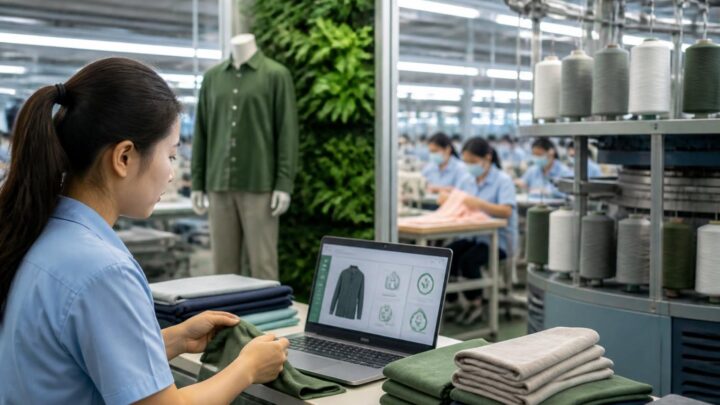
For many years, environmental requirements for exported textiles have focused primarily on chemicals, wastewater, energy and social responsibility. However, the European market is expanding its approach from the production stage to the entire product life cycle. Durability, repairability, recycled material content, reusability and supply chain information are increasingly becoming factors that can influence how a product is designed, placed on the market and circulated.
The Ecodesign for Sustainable Products Regulation, commonly known as ESPR, is an important step in this direction for the European Union. The regulation was issued by the EU in 2024 to create a legal framework for establishing sustainability requirements for a wide range of product groups. Textiles are considered one of the sectors directly related to the implementation of Europe’s circular economy policy, although specific requirements for each product group still need to be determined through subsequent implementing measures.
For Vietnamese textile enterprises, ESPR is not merely a matter of a new technical standard. It is also a challenge involving data management, product design, supplier relationships and the ability to substantiate information throughout the value chain. Businesses that prepare early may reduce risks when European customers change their requirements; in contrast, companies that only collect data when a delivery request arises are more likely to face difficulties with completeness and consistency.
ESPR changes how product sustainability is viewed
Before ESPR was introduced, the EU had an Ecodesign framework that mainly applied to energy-related products. ESPR expands this approach to many other types of goods and emphasizes incorporating environmental factors from the design stage onward. Under the regulation’s direction, requirements may relate to durability, reusability, upgradability, repairability, maintenance, recyclability, resource efficiency and recycled material content.
An important point is that products are no longer assessed solely on the basis of their characteristics at the time of sale. Regulators and buyers may pay greater attention to questions such as whether a product is durable, whether it can be repaired or recycled, how precisely its material composition is identified, and whether a company can provide evidence for its environmental claims.
ESPR also provides a basis for the Digital Product Passport. This is an electronic information system linked to a product that may provide data relating to its origin, composition, performance, repairability, recyclability or other sustainability characteristics, depending on the requirements for each product group. The regulation does not mean that every product must immediately disclose the same set of data. The specific content will depend on the requirements developed by the EU for each industry and product group.
For textiles, this could increase the role of data from fibers, dyes, accessories and finishing processes through to sewing and packaging. Environmental information only has value when a company can demonstrate its origin, calculation method and connection to a specific batch or product.
Why are textiles a focus of circular economy policy?
Textiles have a dispersed supply chain and use many types of raw materials. A product may combine natural fibers, synthetic fibers, elastane, dyes, finishing agents, zippers, buttons, labels and many other accessories. These processes may take place in multiple countries before the product reaches the consumer market.
This complexity makes product life-cycle assessment more difficult than an approach that checks only one stage of production. For example, a garment manufacturer may not directly produce fabric or spin yarn, but may still need information from suppliers if a customer requires the material composition, recycled content or origin of raw materials to be identified. The responsibility for providing data therefore tends to extend throughout the value chain.
The EU has published the Strategy for Sustainable and Circular Textiles as part of the Circular Economy Action Plan. The strategy aims for textiles placed on the European market to be more durable, easier to repair and more recyclable, while being produced under conditions that respect the environment and society. ESPR is one of the legal instruments that can help translate these objectives into specific product requirements.
However, ESPR should not be confused with a complete set of criteria that already applies immediately to all apparel products. Businesses need to distinguish between policy direction, legal obligations that are already in force and specific requirements that will be issued for each product group. This is important to avoid investing based on unconfirmed interpretations or making commercial commitments that exceed the ability to substantiate them.
The biggest challenge is data management, not just technology
From shipment records to product-level data
Many companies already store raw material purchasing documents, test reports, certificates and production records. However, these documents often serve internal controls or meet the requirements of individual orders. As requirements for Digital Product Passports develop, data may need to be standardized, linked and traceable by product, style code or production batch.
The difference between “having records” and “having usable data” is substantial. Disconnected spreadsheets, inconsistent material names or certificates that are not linked to specific product codes reduce the ability to verify information. Companies also need to control data versions, certificate validity periods and the access rights of each partner in the supply chain.
Digitization does not automatically solve the problem if the initial data is inaccurate. Even a modern software system can produce incorrect results if information about fiber composition, blend ratios, chemicals or suppliers is entered incompletely. Therefore, a data project needs to begin with governance processes and the responsibilities of each department, rather than simply selecting a technology tool.
Controlling recycled material claims
Recycled materials are an area where disputes can easily arise if a company does not have appropriate records. Recycled content may be determined in different ways, depending on the material type and assessment method. Companies need to know clearly which standard, certification or records support their claims, how far the claims apply and whether they can be traced back to the supplier.
For recycled fibers, relevant information may include the source of input materials, the conversion process, the quantity used and the relationship between the certification and the specific product. If data is provided only at the factory level but is not clearly allocated to individual orders, explaining the information to customers can become complicated.
This is also why companies need to be cautious with terms such as “green,” “sustainable” or “environmentally friendly.” The broader a claim is, the greater the substantiation requirement. Accurately describing the scope of a specific attribute, such as the recycled content of a fiber, is generally safer than applying a vague environmental label to the entire product.
Impact on Vietnamese textile enterprises
In the short term, ESPR may increase the costs of preparing documentation, testing, supplier assessments and data digitization. Companies with many product codes, multiple raw material sources or continuously changing contract manufacturing models will face a greater management workload. These costs will not necessarily appear as a single investment; they may be distributed across training, audits, software and coordination time between departments.
Pressure may also come from brands and buyers themselves before the legal obligations are fully applied. Brands often establish their own requirements for traceability, emissions, recycled materials and chemicals to support environmental objectives or supply chain management. As a result, Vietnamese companies may have to meet commercial data requirements that are more demanding than the minimum regulatory requirements at a given time.
Conversely, strong data management can become a competitive advantage. Companies can respond more quickly when customers request information, reduce the time spent searching for records, minimize discrepancies between purchasing and production departments, and identify suppliers that do not yet meet the required standards at an early stage. Reliable data also helps companies avoid making environmental commitments that cannot be verified.
ESPR may affect different groups of businesses in different ways. Factories producing goods according to the specifications of international brands may already be familiar with audit and traceability processes. Meanwhile, small and medium-sized enterprises, especially those using many small suppliers, may need more time to build their systems. The appropriate solution is not necessarily to implement a complex platform immediately, but to identify the main export product groups and standardize data starting with the most important links in the chain.
What businesses can prepare from now
First, companies should map the data for each product line. This map should show which types of fibers are used, which entities supply the fabric, where processing stages take place, what information is already available and what information is missing. This approach helps companies identify breaks in the chain instead of checking records only after receiving a customer request.
Next, companies need to standardize material codes, product codes and document storage practices. Using different names for the same type of fiber can cause data to become fragmented between the warehouse, purchasing department and production department. Certificates should also be linked to the supplier, validity period, scope and relevant products instead of being stored as separate files without context.
Businesses should also incorporate data requirements into supplier selection and assessment processes. Price, quality and delivery time remain important criteria, but the ability to provide transparent records will increasingly affect the stability of export orders. Contracts or purchasing agreements can clearly specify the types of information to be provided, the responsibility for updates and how inaccurate data will be handled.
Finally, companies need to distinguish compliance data from communications data. Not every piece of information collected should immediately appear on a product label or in promotional materials. Technical, legal, product development and sales teams should jointly review the content before the company makes environmental claims to customers or consumers.
Outlook depends on specific implementing requirements
The practical impact of ESPR on textiles will depend significantly on the requirements developed by the EU for each product group, as well as on how regulators, buyers and data platforms implement them in practice. Therefore, companies should not monitor only the framework regulation; they also need to keep up with guidance documents, implementation plans and technical requirements relevant to their products.
During the transition period, a prudent approach is to build capabilities that can serve multiple purposes: tracing raw materials, controlling chemicals, substantiating recycled content, monitoring quality and meeting customer requirements. Data that is well standardized for ESPR can also support ESG reporting, life-cycle assessment and supply chain risk management.
For Vietnam’s textile industry, the challenge is not limited to complying with a European regulation. The broader issue is shifting from a model of competition based primarily on production capacity to one that combines quality, speed, transparency and resource efficiency. When product information becomes part of the value of goods, companies that control their data early will have more opportunities to take a proactive role in relationships with international customers.
ESPR should therefore be viewed as a signal to upgrade management systems, rather than merely as an additional requirement at the export stage. Specific legal criteria will continue to be developed, but the direction is clear: textile products seeking more sustainable circulation must be supported by reliable data, responsible design and the ability to substantiate information throughout the product life cycle.
Related articles
The EU’s Sustainable Products Regulation Will Change How Vietnam’s Textile Industry Exports
Vietnam’s textile and apparel industry is preparing for a change that goes beyond tariffs or rules of origin. In the European Union (EU) market, product criteria are increasingly expanding to cover durability, repairability, recycled content, supply chain information, and how products are handled after reaching the end of their life cycle. At the center of
Read more
Vietnam’s Textile and Garment Industry Faces New Requirements for Sustainable Design and the Circular Economy
Vietnam’s textile and garment industry is facing an important shift in the way it approaches the market. Whereas competitiveness was previously assessed mainly through cost, delivery time and the ability to fulfill large orders, criteria related to sustainable design, raw material sources, energy consumption, traceability and the treatment of products after use are playing an
Read more
EU Green Regulations Are Changing How Textile Businesses Prepare Orders
The textile industry is entering a period in which production capacity, cost and delivery time are no longer the only criteria determining competitiveness. For businesses exporting to Europe, information about materials, production processes, product durability and post-use treatment options is increasingly shaping relationships with customers. This change is being driven by the European Union’s policy
Read more
Textile Recycling: What Vietnamese Businesses Need to Prepare for a Circular Supply Chain
For many years, textile recycling in Vietnam was mainly viewed as a waste treatment activity or a corporate social responsibility initiative. That approach is changing. As international brands require suppliers to better control raw materials, chemicals, water, energy and product end-of-life, the ability to participate in a circular supply chain is gradually becoming a competitive
Read more
Textile Recycling: From Waste Management to the Need to Redesign the Value Chain
For many years, recycling was often viewed as the final stage in the life cycle of a garment: clothing that was no longer being used would be collected, sorted, and then converted into raw materials for another product. However, this approach is gradually revealing its limitations. If a product is made from a blend of
Read more
EU Green Regulations Put Vietnam’s Textile and Garment Supply Chain Under New Data and Design Requirements
The European textile and garment market is shifting from an approach focused on production to one that manages the entire product life cycle. A garment is no longer assessed only by its price, seam quality, or delivery time. Design, material composition, repairability, durability, supply chain information, and end-of-life treatment are increasingly becoming part of market
Read more