
Uncategorized
Greenland – A Potential Geopolitical Shock and Its Global Economic Consequences
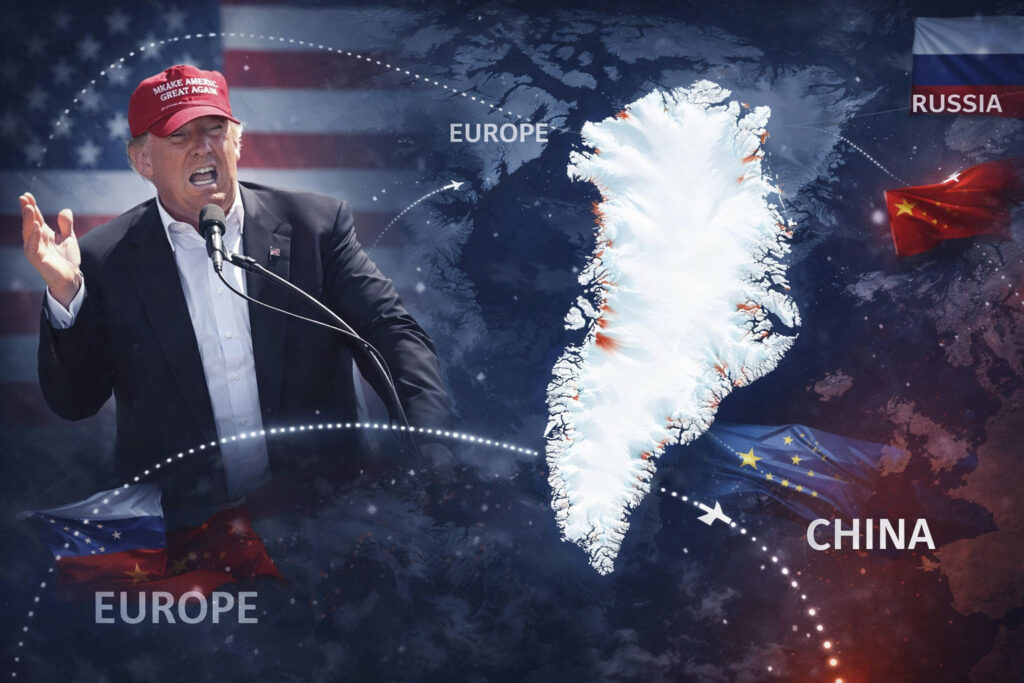
Jan
An Analysis of Impacts on the U.S. Dollar, Gold, Metals, Commodities, and Global Logistics Under Three Confrontation Scenarios
Introduction: When a Remote Island Can Shake the Global Economy
Throughout economic history, major global disruptions have rarely originated in the world’s most populous or commercially vibrant regions. Instead, they often emerge from strategic chokepoints—places where geopolitics, resources, and security intersect. In the 21st century, Greenland is increasingly becoming such a place.
The United States’ growing interest in controlling Greenland, whether directly or indirectly, is not merely a matter of power projection. It represents a potential systemic shock to global financial and commodity markets, particularly at a time when the world economy is already fragile due to persistent inflation, vulnerable supply chains, and declining confidence in the liberal economic order.
The economic consequences of such a development would not be uniform. They would depend critically on how other major powers respond, especially Europe, Russia, and China. Each geopolitical scenario would generate a distinct economic trajectory for the U.S. dollar, gold, industrial metals, energy, and global logistics.
Greenland in the Global Economic Ecosystem: Why Markets Care
Before examining each scenario, it is essential to understand why Greenland—despite its small economy—has the capacity to influence global markets.
First, Greenland sits at the heart of the Arctic and North Atlantic transport nexus, a region where new shipping routes are emerging as ice melts. These routes could significantly shorten travel times between Asia, Europe, and North America. Any instability in this area would immediately translate into higher global logistics costs, which have already been under pressure since the pandemic and the Russia–Ukraine conflict.
Second, Greenland is tied to expectations of strategic supply chain restructuring, particularly in critical raw materials. Even without focusing on individual metal prices, markets are highly sensitive to political developments that could alter long-term access to strategic resources.
Third, and most importantly, Greenland represents a test of confidence in the U.S.-led economic and financial order. Market reactions would be driven less by short-term supply-and-demand dynamics and more by perceptions of credibility, stability, and leadership.
Scenario 1: Mild Reactions – Low Instability and Orderly Market Adjustment
The Macroeconomic Landscape
In this scenario, the United States expands its influence over Greenland through security arrangements and economic cooperation. Denmark and the European Union express diplomatic objections but avoid escalation, while Russia and China limit their responses to rhetoric. There are no sanctions, no military confrontation, and no breakdown in international cooperation.
Economically, this constitutes a soft geopolitical shock—enough to command market attention, but insufficient to trigger panic.
The U.S. Dollar: Stable but Not Surging
With limited instability, the U.S. dollar retains its role as a conditional safe-haven currency. Global capital does not flee the United States, yet neither does it flood in as it would during a major crisis.
Markets interpret the situation as evidence that Washington remains in control and capable of managing strategic expansion without alienating its allies. As a result, the dollar remains stable or strengthens modestly against risk-sensitive currencies, but there is no “super-dollar” cycle.
Gold: A Gradual, Defensive Rise
Gold prices in this scenario reflect moderate risk hedging. Investors increase allocations to gold as insurance against future instability, but they do not view the situation as a systemic crisis.
Gold’s upward movement is slow and steady, driven by:
- Preventive hedging against geopolitical risk
- Long-term expectations of global uncertainty
Industrial Metals and Commodities
Industrial metals benefit indirectly from expectations of infrastructure investment and strategic activity in the Arctic. However, price movements remain expectation-driven rather than supply-driven.
Energy markets and basic commodities experience only mild volatility. No significant supply shock materializes.
Logistics and Services
Logistics costs edge higher due to risk premiums, particularly on North Atlantic routes. Nevertheless, global supply chains continue to function smoothly.
👉 This is the most market-friendly scenario, where instability is absorbed into the background of normal economic conditions.
Scenario 2: Strong but Controlled Reactions – Markets Enter a High-Volatility Phase
The Macroeconomic Landscape
This scenario marks a clear escalation. Denmark reacts forcefully, the EU becomes internally divided, the United States applies diplomatic and economic pressure, and Russia and China openly oppose Washington’s actions.
The global economy enters a phase of systemic but contained instability.
The U.S. Dollar: Stronger, but Controversial
In the early stages, the dollar appreciates sharply due to:
- Flight-to-safety capital flows
- The central role of U.S. financial markets
However, this strength has a dual character. As the United States is increasingly perceived as a source of instability, some investors begin diversifying away from the dollar in the medium to long term.
The dollar remains strong, but confidence in the dollar weakens, resulting in heightened currency volatility.
Gold: A Return to Its Traditional Safe-Haven Role
Gold reasserts itself as a primary destination for defensive capital. Demand rises not only from private investors but also from central banks in emerging markets seeking to reduce exposure to geopolitical risk.
Gold prices rise faster than in Scenario 1, reflecting:
- Fears of geopolitical fragmentation
- Concerns about the politicization of the financial system
Industrial Metals and Commodities
Industrial metal prices increase as markets price in:
- Potential supply chain disruptions
- Higher financing and insurance costs
Energy markets become particularly volatile, especially in Europe, which is already sensitive to geopolitical shocks. Commodity prices increasingly reflect geopolitical risk premiums, rather than pure supply-demand fundamentals.
Logistics: Emerging Bottlenecks
Logistics costs rise significantly:
- Marine insurance premiums increase
- Arctic and North Atlantic routes face tighter monitoring
Global corporations begin reassessing supply chains, prioritizing resilience over cost efficiency.
This scenario risks reigniting inflation, even as economic growth slows.
Scenario 3: Full Confrontation – A Global Economic Shock
The Macroeconomic Landscape
In the worst-case scenario, the United States confronts Denmark, the European Union, Russia, and China simultaneously. Sanctions, counter-sanctions, and Arctic militarization occur in parallel. The global economy enters a period of prolonged, structural instability, more complex than the Cold War.
The U.S. Dollar: Short-Term Haven, Long-Term Risk
Initially, the dollar surges as panic drives capital toward the most liquid asset available. Over time, however, a paradox emerges:
- The dollar remains strong because there is no immediate alternative
- The dollar weakens structurally as trust erodes
Many countries accelerate partial de-dollarization, particularly in commodity trade and reserve management.
Gold: The Ultimate Systemic Hedge
In this scenario, gold ceases to be merely an investment asset and becomes a tool of systemic preservation. Demand comes from:
- Central banks
- Hedge funds
- High-net-worth individuals
Gold prices rise sharply and remain elevated for an extended period.
Metals, Energy, and Commodities: Structural Inflation
Prices of industrial metals and energy rise not cyclically, but due to structural shortages. Fragmented supply chains and geopolitical blocs permanently increase production costs.
Commodities evolve into instruments of power, no longer governed by free-market logic alone.
Logistics: Global Reconfiguration
Logistics becomes the most severely affected sector:
- Transport routes split along geopolitical lines
- Shipping costs rise sharply and remain high
- Corporations are forced to regionalize production
This is a scenario of high inflation, low growth, and prolonged instability.
Greenland and the Emerging Economic Order
Greenland is not the root cause of global instability—it is a catalyst. It exposes the fragility of the global economic system, where geopolitics increasingly dictate prices, capital flows, and supply chains.
Across all three scenarios, one conclusion stands out:
the world is moving away from a low-cost stability model toward a high-cost instability era.
The key question is no longer whether markets will experience volatility, but how severe and how persistent that volatility will be. In this new era, economic outcomes will increasingly reflect political power rather than market fundamentals.

Bài Viết Liên Quan
Bài Viết Cùng thể loại