Agricultural · 12 November, 2026
The Circular Economy Is Reshaping the Textile Value Chain

The textile industry is entering a phase in which production capacity and labor costs are no longer the only factors determining competitiveness. How companies use materials, design products, manage chemicals, handle waste, and provide data to customers is increasingly having a direct impact on their ability to retain orders.
This trend stems from two main directions. On the one hand, major consumer markets are developing regulations to extend product lifespans, improve recyclability, and limit waste. On the other hand, international brands are under pressure to demonstrate the sources of their materials, production conditions, and environmental impacts throughout the entire supply chain. For Vietnamese textile factories and businesses, the circular economy is therefore no longer merely a social responsibility program but is gradually becoming a commercial requirement.
From Linear Production to a Circular Value Chain
The traditional textile industry model typically operates along the chain of “extracting materials, producing, consuming, and discarding.” Fabric is made from natural or synthetic fibers, cut and sewn into products, delivered to consumers, and may eventually end up in a landfill or incinerator. Some products are reused or collected, but in many markets these activities have not yet formed a coordinated system.
The circular economy takes a different approach. Products need to be designed to last longer, be easy to repair and disassemble, and facilitate reuse or recycling. Waste from one stage can become an input for another. Companies must also consider the entire product life cycle rather than optimizing only an individual stage, such as reducing cutting and sewing costs or increasing delivery speed.
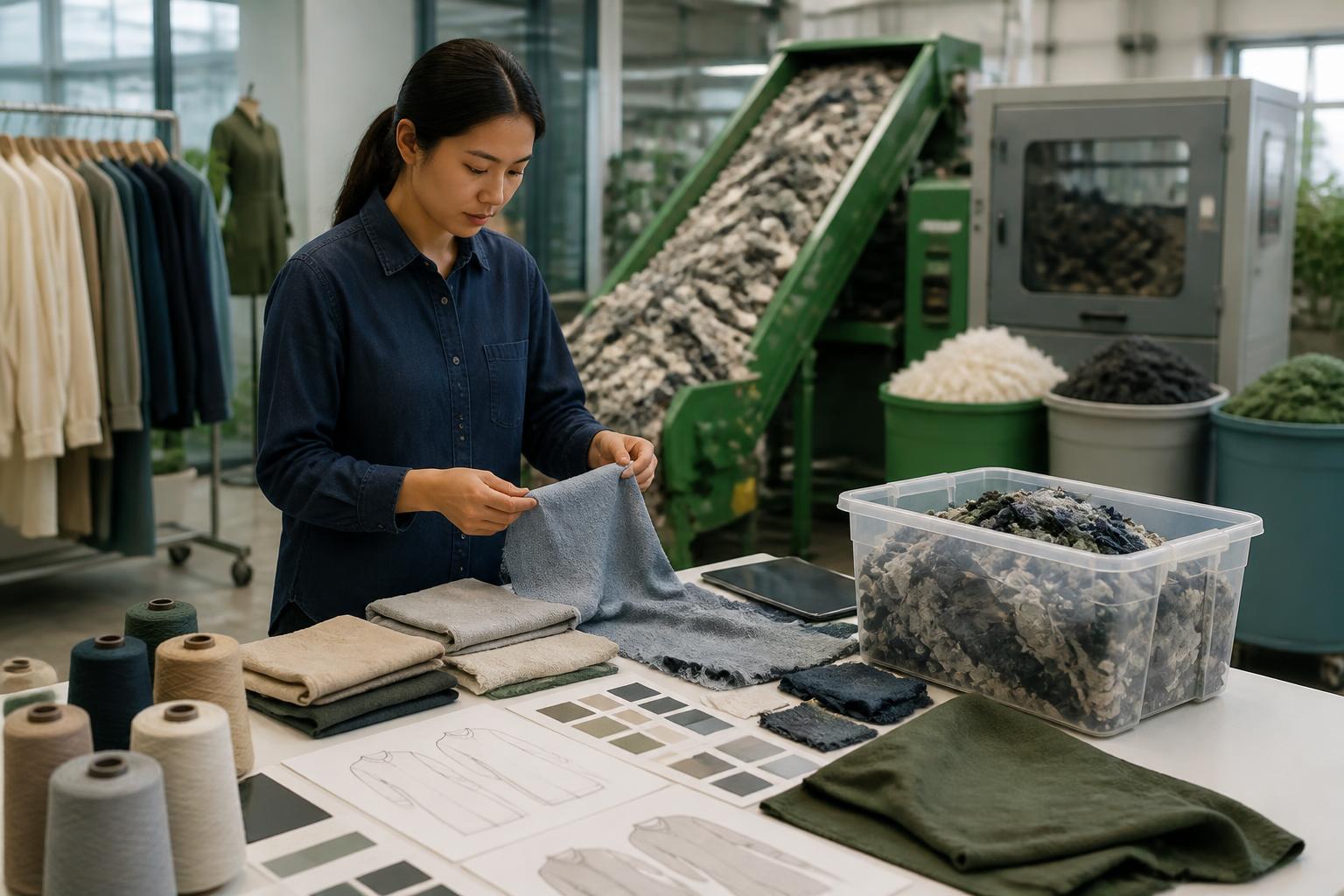
In textiles, the transition to circularity can take place at multiple levels. At the material level, companies can increase their use of recycled fibers, regenerated fibers, or materials with certified origins. At the design level, garments can be created with simpler structures that reduce difficult-to-separate blends of different fibers. At the production level, defective fabric, offcuts, and cutting waste need to be sorted for reuse instead of being mixed with ordinary waste.
However, circularity does not mean that every recycled material is automatically more sustainable. Actual effectiveness depends on the source of the material, processing technology, energy consumption, the quality of the recycled product, and the ability to recover it at the end of its life. This is why brands and buyers increasingly require detailed data instead of general claims about being “green” or “environmentally friendly.”
European Regulations Create New Pressure for Businesses
Product Design Becomes a Central Focus
The European Union has introduced the Ecodesign for Sustainable Products Framework, enacted as Regulation (EU) 2024/1781. This legislation expands the ecodesign approach from energy-related products to a wider range of product groups, while providing a basis for requirements concerning durability, repairability, recyclability, resource efficiency, and product information.
Textiles are among the sectors receiving particular attention in the EU’s sustainable product policy. Detailed requirements for each product group cannot be inferred solely from the fact that the framework regulation has entered into force; businesses still need to monitor implementing legislation, technical standards, and relevant market requirements. Nevertheless, the overall direction is clear: product design will affect market access just as much as production capacity.
This change may alter how companies accept orders. Previously, a factory mainly received specifications regarding style, material, color, fabric weight, and delivery deadlines. Under the new model, the technical file may also need to include information about fiber composition, the proportion of recycled materials, dyes, finishing treatments, durability, repairability, and end-of-life options.
Digital Product Passports and Data Requirements
One of the important tools in sustainable product policy is the Digital Product Passport. In principle, this tool allows information related to a product to be stored and shared, such as the sources of its materials, technical characteristics, repairability, recyclability, or post-use treatment. The specific implementation depends on the regulations for each product group and the accompanying data standards.
For textile companies, this requirement highlights an issue that is often treated as administrative work: data management. Information about fibers may be held by the material supplier, dyeing data may be located at the finishing facility, while packaging or transportation information may belong to another entity. Without batch codes, verification procedures, and a consistent storage system, companies will find it difficult to prove that a product was actually made from the materials declared.
Data digitization is not intended only to meet regulatory requirements. Brands need data to evaluate suppliers, calculate environmental impacts, and manage supply-chain risks. As a result, companies able to provide information quickly, accurately, and in a verifiable form may have an advantage when participating in long-term purchasing programs.
Bottlenecks in Textile Recycling
Textile recycling is often viewed as a central solution of the circular economy, but it is an area with many technical limitations. A product may contain multiple types of fibers, accessories, coatings, sewing threads, and finishing chemicals. When these components are not sorted from the beginning, processing costs increase and the quality of recovered materials declines.
Blended fabric made from natural and synthetic fibers is a typical example. This type of fabric may provide suitable performance characteristics, but separating each type of fiber after the product has been discarded is more complex than processing a single-component material. Mechanical recycling can also reduce fiber length, making the processed material less suitable for returning to products with high quality requirements.
Chemical recycling creates opportunities to process some more complex materials, but it requires technology, a stable supply, and a chemical control system. Not every production facility can invest in its own recycling line. Therefore, the industry needs collection, sorting, and processing networks that are large enough to reduce the cost per unit of material.
In Vietnam, another challenge is the fragmentation of the supply chain. Textile production, dyeing, sewing, supporting processes, and scrap collection may be handled by many independent businesses. Production waste often has different values depending on the fiber type, color, and level of cleanliness. If it is not sorted at the source, opportunities for reuse will decline and companies will find it difficult to control the proportion of recovered materials.
This shows that recycling cannot be addressed simply by purchasing more recycled materials. Companies need to design sorting processes, reduce waste, preserve recovered materials, and verify the sources of incoming materials at the same time. If one link is missing, a claim of circularity may not accurately reflect the impact of the entire product.
Where Should Vietnamese Businesses Start?
Measure Before Investing
For many businesses, the first step does not necessarily involve immediately investing in expensive technology. The priority is to map material and waste flows at each stage. A factory needs to know the amount of incoming fabric, the loss rate during cutting, the types of waste generated, the amount of water and energy used, and how each waste stream is handled.
This basic data helps companies identify the issues with the greatest impact. One workshop may be able to significantly reduce costs by optimizing marker layouts and reducing excess fabric, while another may need to prioritize wastewater treatment or change its chemicals. There is no single roadmap for every business; effectiveness depends on the company’s size, product type, technology, and position in the supply chain.
During this process, it is necessary to distinguish between data measured directly and data provided by suppliers. Material certifications can support verification, but they do not completely replace an internal control system. Purchasing records, batch codes, test results, and production reports need to be linked to form a consistent chain of evidence.
Redesigning Relationships with Suppliers
The ability to transition to a circular model depends significantly on the relationship between garment companies and their suppliers of fibers, fabrics, chemicals, and accessories. If companies only ask suppliers to offer the lowest prices and fastest delivery, it will be difficult to create room for more transparent materials or solutions that reduce environmental impacts.
Longer-term contracts, stable material specifications, and data-sharing mechanisms can help suppliers invest in technology. At the same time, garment companies need to assess suppliers’ ability to deliver rather than issuing broad environmental requirements without measurable criteria. A clear set of requirements with a roadmap and regular inspections is generally more valuable than general commitments.
For small and medium-sized enterprises, cluster-based cooperation may be a practical approach. Several businesses can jointly use testing, scrap collection, waste treatment, or traceability software services. This approach helps reduce individual investment costs and creates a sufficient volume of materials for recyclers.
Competitive Advantage Lies in the Ability to Prove
The transition may require companies to change designs, test new materials, train employees, digitize records, and invest in quality control. Some recycled materials also have characteristics that are not entirely identical to virgin materials, meaning product development may require additional time.
However, the cost of failing to transition is becoming increasingly clear. Without data on material sources and production processes, companies may face difficulties participating in supply chains that require traceability. Without controlling chemicals and waste, meeting brand standards will become more costly. If companies compete only on processing prices, they may easily be replaced as the market shifts toward suppliers with stronger data and compliance capabilities.
Vietnamese businesses’ advantage may lie in combining production capabilities with supply-chain management. A factory does not necessarily need to own all recycling technologies itself, but it must understand where materials come from, how they are processed, and how this can be demonstrated. The ability to fulfill future orders will also include the ability to report, verify, and share data.
The circular economy also opens up new business models, such as repair, reuse, post-consumer product collection, and remanufacturing. These models require coordination among manufacturers, brands, retailers, consumers, and waste-treatment companies. For Vietnam, establishing an organized collection and sorting market will be an important condition for investments in recycling to be effective.
In the coming period, textile companies should simultaneously monitor three groups of changes: sustainable product regulations in export markets, data requirements from brands, and developments in recycling technology. Not every requirement will take effect immediately, but the time needed to prepare data systems, suppliers, and control processes is often longer than businesses expect.
The circular economy should therefore not be viewed as a marketing slogan or as a separate project for the environmental department. It is an issue involving design, purchasing, production, quality, information technology, and market strategy. Businesses that begin by accurately measuring, controlling data, and improving each material flow will have a stronger foundation for adapting to a textile supply chain that is shifting toward greater transparency and sustainability.
Related articles
Digital Product Passports: A New Turning Point for the Textile Industry in the Green Supply Chain
The textile industry is entering a phase in which on-time delivery and cost control are no longer the only criteria determining competitiveness. Data on raw material sources, fiber composition, chemicals used, production processes, durability, and recyclability is increasingly regarded as part of a product’s value. Against this backdrop, the digital product passport, commonly known as
Read more
The EU’s Sustainable Products Regulation Will Change How Vietnam’s Textile Industry Exports
Vietnam’s textile and apparel industry is preparing for a change that goes beyond tariffs or rules of origin. In the European Union (EU) market, product criteria are increasingly expanding to cover durability, repairability, recycled content, supply chain information, and how products are handled after reaching the end of their life cycle. At the center of
Read more
EU Green Regulations Are Changing How Textile Businesses Prepare Orders
The textile industry is entering a period in which production capacity, cost and delivery time are no longer the only criteria determining competitiveness. For businesses exporting to Europe, information about materials, production processes, product durability and post-use treatment options is increasingly shaping relationships with customers. This change is being driven by the European Union’s policy
Read more
Textile Recycling: What Vietnamese Businesses Need to Prepare for a Circular Supply Chain
For many years, textile recycling in Vietnam was mainly viewed as a waste treatment activity or a corporate social responsibility initiative. That approach is changing. As international brands require suppliers to better control raw materials, chemicals, water, energy and product end-of-life, the ability to participate in a circular supply chain is gradually becoming a competitive
Read more
Textile Recycling: From Waste Management to the Need to Redesign the Value Chain
For many years, recycling was often viewed as the final stage in the life cycle of a garment: clothing that was no longer being used would be collected, sorted, and then converted into raw materials for another product. However, this approach is gradually revealing its limitations. If a product is made from a blend of
Read more
EU Green Regulations Put Vietnam’s Textile and Garment Supply Chain Under New Data and Design Requirements
The European textile and garment market is shifting from an approach focused on production to one that manages the entire product life cycle. A garment is no longer assessed only by its price, seam quality, or delivery time. Design, material composition, repairability, durability, supply chain information, and end-of-life treatment are increasingly becoming part of market
Read more